

Introduction
Heavy industry does not run on “universal” engineering alone. Even when OEM catalogs, ISO standards, and simulation tools are the same worldwide, the engineering practices that govern how drive systems are selected, installed, operated, and maintained vary noticeably by region. Those differences change real outcomes: uptime, coupling life, gearbox temperature margins, alignment stability, spare strategy, and how failures propagate across a drivetrain.
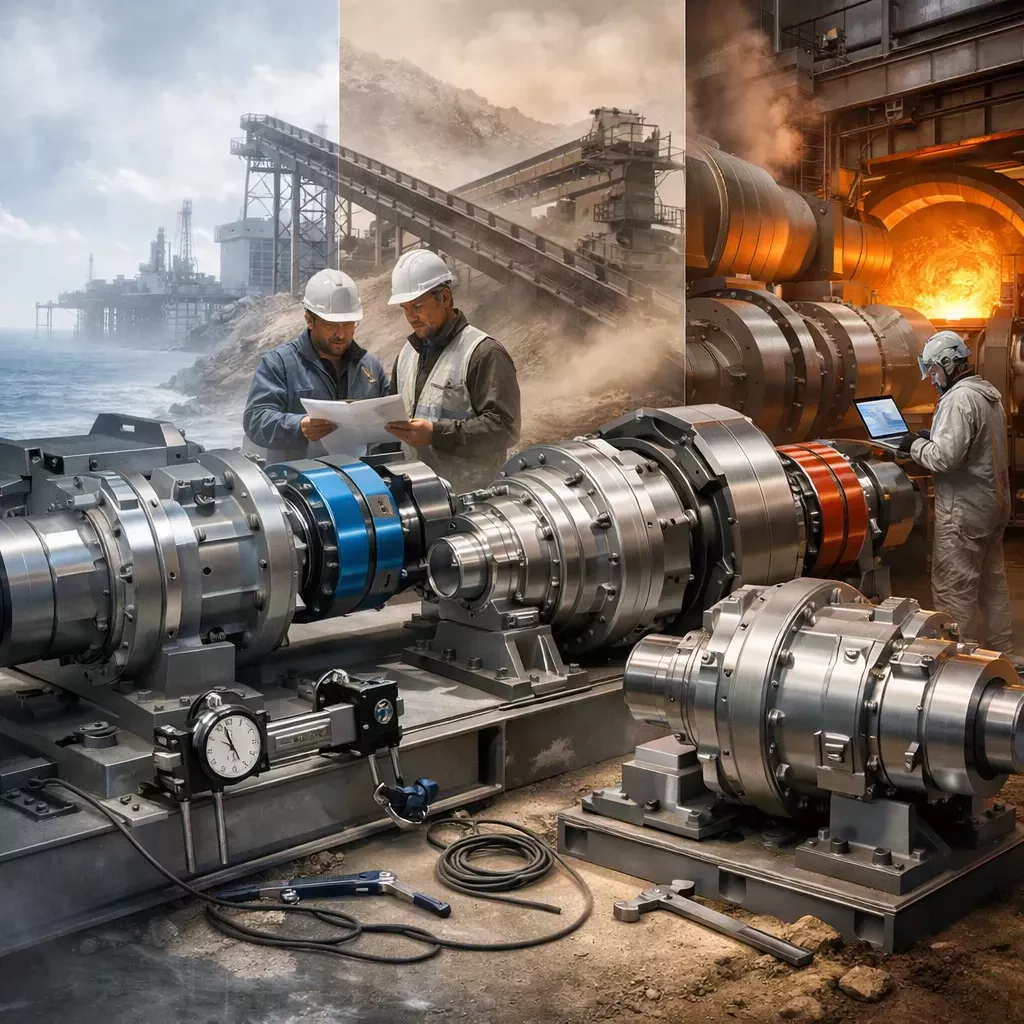
This matters most in systems where industrial couplings and planetary gearboxes sit at the boundary between theoretical design and field reality. A coupling is often the “policy layer” that absorbs installation uncertainty and transient loads, while a planetary gearbox concentrates torque density and exposes sensitivity to lubrication, thermal balance, and load spectra. Regional practice determines whether these components are used within their intended envelope—or quietly pushed beyond it.
What “Regional Engineering Practice” Actually Means (Not Stereotypes)
When we say “regional practice,” we are not describing nationality-based assumptions. We’re describing repeatable patterns driven by:
- Grid quality and power stability (frequency variation, voltage dips, harmonic content)
- Workforce skill distribution (commissioning and alignment culture, metrology access)
- Maintenance philosophy (reactive vs condition-based, spare parts availability)
- Procurement structure (lowest bid vs lifecycle cost, approved vendor lists)
- Ambient conditions (temperature, dust, humidity, salt fog, altitude)
- Regulatory and insurance environment (compliance enforcement, audit depth)
- Process industry mix (cement vs steel vs mining vs marine = different load spectra)
The key engineering point: the same drivetrain design can be robust in one region and fragile in another purely due to differences in installation tolerance, operating transients, and maintenance maturity.
Region-Driven Design Inputs That Change Drive System Architecture
1) Power Quality → Transients, Torsional Excitation, and Thermal Drift
In some regions, plants operate with:
- frequent brownouts,
- generator-based microgrids,
- weak utility grids,
- or high non-linear loads (VFD-heavy networks without adequate filtering).
These conditions increase:
- start/stop frequency,
- torque ripple,
- torsional oscillation,
- and motor thermal cycling.
Engineering consequence: OEMs often adopt more conservative torsional margins and select coupling architectures that provide controlled compliance and damping to prevent torque ripple from exciting the drivetrain. Elastomer-based coupling families are frequently used as a practical damping layer in the mechanical system
2) Installation Culture → Alignment Targets vs Alignment Reality
Regional differences in commissioning practice are one of the biggest hidden variables in heavy industry.
Typical divergences include:
- laser alignment availability vs dial-only alignment,
- baseplate grouting quality,
- soft-foot elimination discipline,
- thermal growth compensation (hot alignment) culture,
- and the habit of rechecking alignment after the first thermal cycles.
Engineering consequence:
Where alignment uncertainty is higher, teams intentionally favor couplings that tolerate misalignment without converting it into destructive bearing loads, seal wear, or gearbox input-stage stress. This is not “forgiving poor work”—it is risk management for real field distributions of alignment error.
3) Dust, Abrasion, and Water Ingress → Sealing Strategy and Coupling Selection
Cement, mining, and bulk handling environments vary by region in:
- silica dust concentration,
- washdown practices,
- rainfall and humidity cycles,
- and enclosure standards.
Engineering consequence:
- Planetary gearboxes are sensitive to contamination and thermal imbalance; sealing, breather strategy, and oil cleanliness become design-critical. Gearbox architecture selection often shifts toward variants and options that better support harsh environments (planetary drive context: SEAWIDE-GEAR).
- Coupling guards, element materials, and inspection accessibility become primary selection criteria—not secondary details.
4) Maintenance Economics → “Sacrificial” Components vs Full-Asset Protection
Where downtime cost is extreme and spares are well-managed, the system is designed so that:
- the coupling becomes a replaceable protection layer,
- preventing expensive gearbox and motor failures.
Where spares are scarce or lead times are unpredictable, the strategy shifts toward:
- maximizing mean time between interventions,
- using more conservative load margins,
- and emphasizing condition monitoring triggers.
Engineering consequence:
Coupling selection is often driven by whether the site can reliably replace elements, keep stock, and perform inspections. A design that assumes “quick element swaps” fails if the region’s logistics cannot support it.
Practice Patterns Commonly Seen in Heavy Industry (By Engineering Driver)
A) High-Temperature Regions (Thermal Margin as the Dominant Constraint)
In hot climates (or plants with high radiant heat), practices often evolve toward:
- stricter oil temperature monitoring,
- conservative service factors,
- additional cooling options,
- and attention to coupling heat aging behavior.
Engineering consequences
- Gearbox selection emphasizes thermal ratings, lubrication regime stability, and derating logic.
- Coupling materials must maintain stiffness/damping balance across temperature range; thermal aging becomes a lifecycle variable rather than a theoretical footnote.
B) Coastal / Marine-Adjacent Regions (Corrosion and Salt Fog as a Failure Accelerator)
Salt fog and moisture ingress drive:
- corrosion of coupling hardware,
- degradation of guards and fasteners,
- seal hardening,
- and reduced reliability of breathers.
Engineering consequences
- Protective coatings and stainless hardware practices become non-negotiable.
- Inspection intervals tend to shorten, and coupling/gearbox interfaces are designed to avoid crevices and stagnant moisture traps.
C) Mining-Dominant Regions (Shock Loading + Low Predictability)
Mining duty cycles create:
- severe shock events,
- variable load spectra,
- frequent starts under load,
- and high misalignment potential due to structural movement.
Engineering consequences
- System-level torsional design is prioritized; coupling damping and overload behavior become central.
- Gearbox selection favors architectures that handle transient overloads without accelerating bearing and gear surface damage.
How OEMs Adapt: Three Typical “Regionalization” Strategies
1) Conservative Global Design (One SKU, Many Environments)
OEMs choose a robust baseline configuration to reduce risk. This is common in large-scale projects and multi-country deployments.
Trade-off: higher CAPEX, simpler commissioning and spares.
2) Option Packages (Modular Regional Adaptation)
OEMs provide option sets:
- sealing packages,
- breather and filtration upgrades,
- cooling variants,
- different coupling element grades,
- monitoring ports and sensor-ready housings.
Trade-off: more configuration effort, better lifecycle performance.
3) Site-Specific Engineering (Best Technical Outcome, Highest Engineering Cost)
The drivetrain is tuned to:
- measured load spectra,
- local power quality,
- thermal mapping,
- and maintenance capability.
Trade-off: best reliability outcome, but requires strong data and governance.
Practical Engineering Checklist (Use This Before You Lock the Design)
Use this checklist to translate “regional practice” into hard design inputs:
-
Power Quality Reality
- VFD presence, harmonic mitigation, brownout frequency, generator operation
-
Alignment Capability
- laser tools? hot alignment practice? baseplate/grout discipline?
-
Ambient and Contamination
- dust class, washdown, humidity cycles, salt fog exposure
-
Maintenance Model
- reactive vs CBM, available spares, procurement lead times
-
Downtime Cost
- single-line bottleneck? redundancy? restart penalties?
-
Compliance Enforcement
- audit strictness, guarding norms, documentation requirements
Engineering Summary
Regional engineering practices in heavy industry are not “preferences”; they are adaptive responses to local constraints. The most reliable drive systems are those designed with regional reality as an explicit input—especially where couplings and planetary gearboxes define how misalignment, transients, contamination, and maintenance behavior translate into failure or survivability.
