

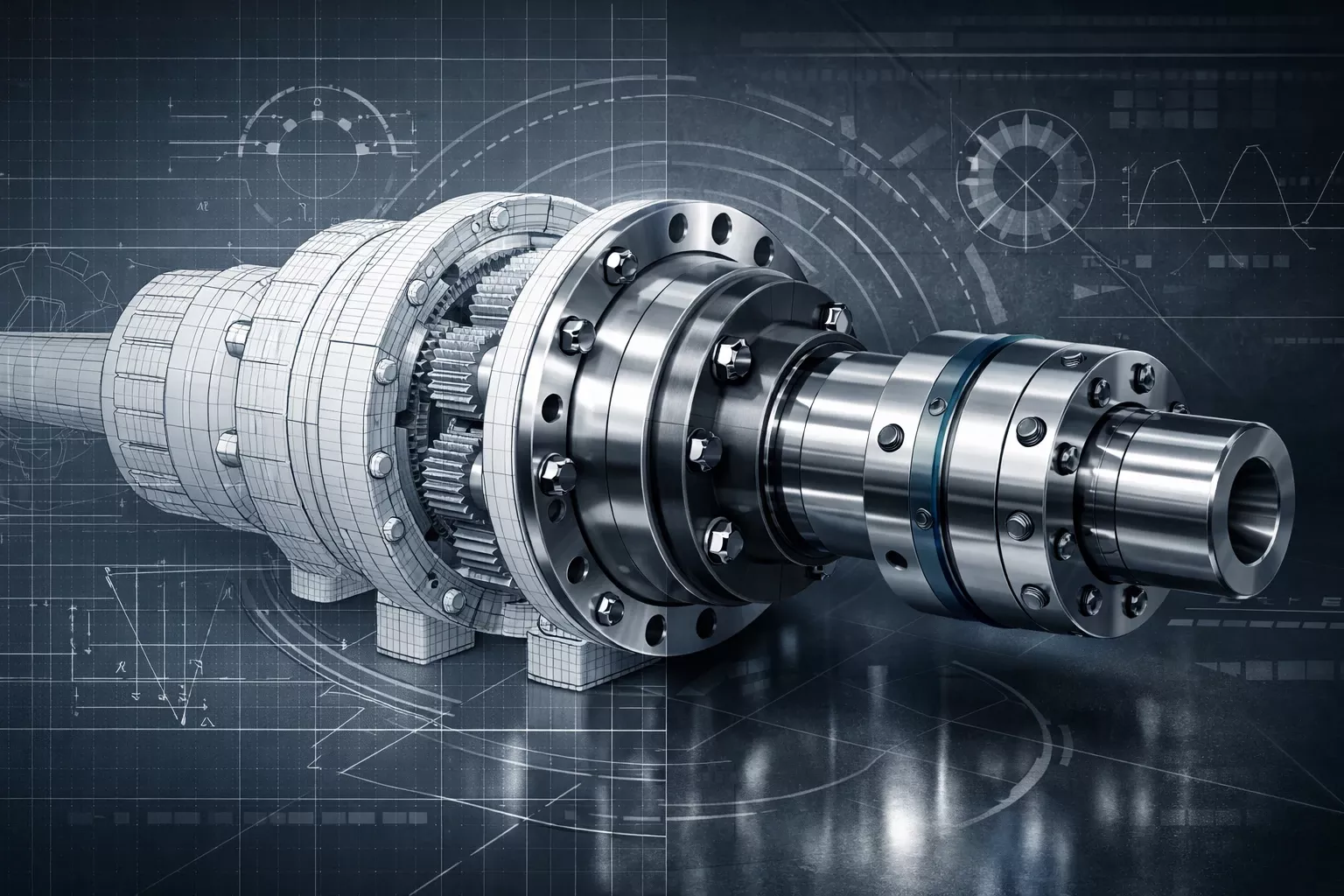
Industry Standards Influencing Drive System Architecture
Introduction
In the engineering of heavy-duty power transmission, “Industry Standards” are far more than regulatory checkboxes; they are the mathematical and geometric constraints that dictate the very architecture of a drive system. Whether designing a multi-stage planetary gearbox or selecting a high-performance coupling, the choice of standard—be it ISO, AGMA, DIN, or API—directly influences component sizing, material selection, safety margins, and failure predictability.
Understanding how these standards interact is critical for systems engineers. A drive system is an assembly of interdependent components where a standard governing the gearbox (e.g., ISO 6336) must harmonize with the standards governing the interface (e.g., AGMA 9000-E for couplings). Discrepancies between these frameworks can lead to “bottlenecking,” where the theoretical life of a gearbox is undermined by an improperly rated coupling or an underestimated service factor.
The Hierarchy of Standards in Drive Design
1) Gear Geometry and Rating Standards (ISO vs. AGMA)
The architecture of a Planetary Gearbox is primarily governed by two dominant schools of thought: ISO 6336 (International) and AGMA 2101/2001 (North American).
- ISO 6336: Focuses heavily on detailed analytical calculation of load capacity, considering factors like tooth flank longitudinal load distribution (KHβK_{H\beta}) and dynamic factors (KvK_v). It is often perceived as more “precise” for European-origin planetary designs.
- AGMA: Historically uses a more empirical approach with “Service Factors” that wrap several uncertainties into a single multiplier.
Architectural Impact:
When shifting from an AGMA-rated system to an ISO-rated one, the physical size of the gear set may change even if the torque requirement remains identical. This is because the standards calculate pitting resistance and bending strength using slightly different stress-cycle (S−NS-N) curves. For engineers looking at high-torque density, understanding these rating nuances is vital for selecting the correct planetary drive.
2) Coupling Interface and Balancing Standards (API & AGMA)
For the “mechanical bridge” between the motor and the gearbox, standards like API 671 (Special Purpose) or API 610 (General Purpose) and AGMA 9000-E define the architecture of the coupling.
- API 671: Mandates strict requirements for balance, material traceability, and “non-sparking” features. It often dictates a double-engagement disc or diaphragm coupling architecture to ensure the system can handle high speeds and thermal growth without transmitting axial thrust to the gearbox bearings.
- AGMA 9000-E: Provides the framework for calculating misalignment capacities and axial end-float.
Architectural Impact:
If a system must comply with API 671, the coupling becomes a highly engineered, balanced component that dictates longer shaft separations (DBSE – Distance Between Shaft Ends) to accommodate the required flexibility. This changes the overall footprint of the drive skid. For standard industrial applications, the choice of elastomer-based couplings often follows DIN standards for interchangeable hubs
How Standards Dictate Component “Life” (L10 and Durability)
Standards do not just define how to build; they define how long it lasts. In drive system architecture, two metrics are king:
1) Bearing Life (ISO 281)
The L10 life (the life that 90% of a group of identical bearings will exceed) is the standard baseline. However, in planetary gearboxes, the planet bearings operate in a unique environment (rotating outer rings, centrifugal loads). Standards like ISO/TS 16281 provide advanced calculations that account for internal load distribution and misalignment.
2) Service Factors (The “Safety Architecture”)
The Service Factor (SF) is the most visible standard-driven constraint.
- A conveyor drive might require an SF of 1.5.
- A heavy crusher might require an SF of 2.5.
These multipliers are defined by standards based on the “Uniformity of Load.” If the standard dictates a high SF, the architecture must scale up: larger shafts, wider gear faces, and couplings with higher peak-torque ratings.
Industry-Specific Standards and Their Constraints
Different sectors impose “super-standards” that override general mechanical rules:
| Industry | Primary Standard(s) | Impact on Drive Architecture |
|---|---|---|
| Marine & Offshore | DNV-ST-0378 / Lloyd’s Register | Higher safety factors, mandatory material certification, and redundant sealing requirements. |
| Oil & Gas | API 613 (Gears) / API 671 (Couplings) | Focus on extreme reliability and “fail-safe” behavior; often requires specialized monitoring ports. |
| Mining & Cement | DIN 3990 / AGMA 6014 | Optimized for shock loading and abrasive environments; dictates massive thermal margins. |
| Wind Energy | IEC 61400-4 | Specific to planetary stages; focuses on complex load cases and non-torque loads (bending moments). |
The Shift Toward “Digital Standards” (ISO 10303 – STEP)
Modern drive system architecture is increasingly influenced by data exchange standards. The ability to move a 3D model of a planetary gearbox into a system-level simulation (like Romax or MASTA) relies on standardized CAD and metadata protocols. This allows engineers to see how a “standard” gearbox reacts to “non-standard” system vibrations before a single bolt is turned.
Engineering Checklist: Aligning Standards with Architecture
When defining the architecture of a new drive system, ask:
- What is the primary rating standard? (Ensure the motor, coupling, and gearbox are all using compatible service factor logic).
- Does the application require specialized compliance? (e.g., ATEX for explosive environments, or API for critical process pumps).
- Are the interfaces standardized? (Check for ISO/DIN shaft tolerances to ensure the coupling fits without field-machining).
- Is the “Design Life” standardized? (Confirm if the 20,000-hour requirement is based on L10 or a more conservative modified life calculation).
Conclusion
Industry standards are the “DNA” of drive system architecture. They provide the language that allows a planetary gearbox from one manufacturer to work seamlessly with a coupling from another. By adhering to these technical frameworks, engineers move away from “guesswork” and toward predictable, reliable, and interchangeable industrial power transmission.
