
Standardization Versus Customization in Drive Design
Introduction
In industrial drive engineering, the tension between standardization and customization is not a theoretical discussion but a daily engineering reality. Every gearbox ratio, coupling stiffness, bearing arrangement, or mounting interface embeds assumptions about load behavior, alignment stability, thermal growth, and maintenance discipline. The strategic decision is therefore not whether standard or custom solutions are “better,” but whether the assumptions behind the chosen architecture actually match the operating environment. When they do, standardized systems deliver impressive reliability. When they do not, customization becomes an engineering necessity rather than a luxury.
The Engineering Meaning of Standardization
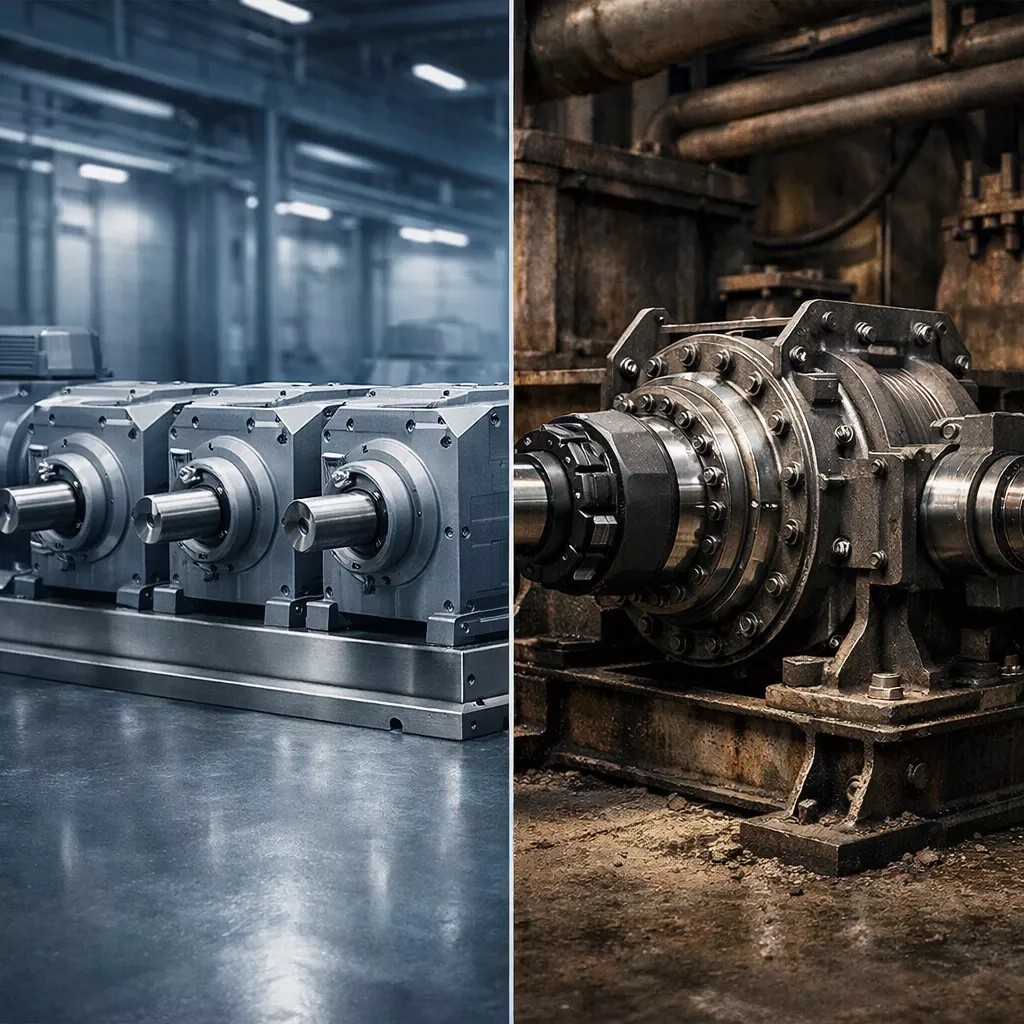
Standardization in drive design extends far beyond selecting catalog components. It represents an intentional decision to lock system behavior within predefined envelopes of torque, speed, misalignment, and service factor. Standardized drive architectures assume relatively stable load profiles, predictable installation quality, and controlled operating conditions. Within these boundaries, performance becomes repeatable and failure modes are well understood. This predictability is why modular gearboxes and standardized coupling interfaces dominate OEM platforms that scale across multiple machines and markets.
From a system perspective, standardized stiffness values, backlash ranges, and bearing arrangements allow engineers to model torsional response and bearing life with confidence. Over time, accumulated field data reinforces these assumptions, creating a feedback loop where reliability improves through repetition rather than redesign.
Why Standardization Often Works Better Than Expected
The real strength of standardized drive systems lies not in mechanical perfection, but in organizational consistency. Installers understand acceptable tolerances, maintenance teams recognize early failure symptoms, and spare parts logistics remain simple. These human and procedural factors often contribute more to uptime than incremental efficiency gains from bespoke solutions. In environments where operating conditions closely resemble the catalog design envelope, standardized drives frequently outperform more complex custom systems simply because they are used correctly and consistently.
The Limits of Standardization Under Real Operating Conditions
Problems emerge when real-world behavior drifts outside the assumed envelope. Transient torque spikes, uneven load sharing, structural deflection, or significant thermal gradients can all invalidate standardized assumptions. In such cases, stiffness that was acceptable on paper may transmit harmful loads into gearbox bearings or seals. This is especially common when rigid couplings are paired with standardized gear units on flexible foundations, where misalignment is inevitable rather than exceptional. In these scenarios, the ability of elastomeric or torsionally adaptive couplings to decouple alignment error from bearing load becomes a system‑level reliability factor, a principle widely applied in industrial installations that integrate flexible coupling solutions such as those discussed throughout the application literature at SEAWIDE-RUBBER.
Customization as Assumption Control
Customization is fundamentally about replacing generic assumptions with measured realities. Instead of accepting default service factors or stiffness values, engineers tailor the drive system to the actual load spectrum, thermal behavior, and structural interaction of the machine. This may involve modifying gear ratios to reduce transient stress, adjusting coupling stiffness to shift torsional natural frequencies, or redesigning bearing arrangements to better manage axial or radial loads. Customization allows engineers to actively shape load paths rather than merely tolerate them.
In heavy-duty applications, particularly those involving planetary gear stages, customization often focuses on housing stiffness, load sharing behavior, and interface geometry. Tailored planetary solutions, similar in philosophy to application‑specific adaptations discussed in advanced gearbox platforms like those commonly evaluated at SEAWIDE-GEAR, demonstrate how targeted customization can dramatically extend bearing life and reduce vibration under non-ideal conditions.
Rethinking the Cost of Custom Drive Solutions
The assumption that customized drive systems are always more expensive is largely a consequence of short-term thinking. While initial capital cost may increase slightly, lifecycle economics frequently favor customization. Reduced downtime, lower secondary damage, and clearer responsibility boundaries during failure analysis often offset higher upfront engineering effort. In industries where unplanned downtime carries significant financial or safety consequences, customization is less a cost driver than a risk mitigation strategy.
Hybrid Architectures and Controlled Standardization
Mature OEMs rarely operate at either extreme. Instead, they apply controlled standardization, retaining standardized internal gear stages and bearings while customizing interfaces, coupling characteristics, or mounting arrangements. This hybrid strategy preserves supply chain efficiency while allowing the system to adapt to real installation constraints. By selectively customizing only the parameters that influence system behavior, engineers achieve a balance between repeatability and resilience.
Risk Allocation and Engineering Accountability
An often overlooked dimension of this decision is risk ownership. Standardized systems implicitly shift risk toward the integrator or end user, relying on compliance with assumed operating conditions. Customized systems, by contrast, pull responsibility back toward the designer or OEM, who explicitly acknowledges and engineers around uncertainty. In regulated or high‑consequence environments, this clarity of accountability can be as valuable as the mechanical optimization itself.
Conclusion
Standardization and customization are not opposing philosophies but complementary engineering tools. Standardization excels when reality aligns with assumptions, delivering efficiency through repetition and organizational stability. Customization excels when uncertainty dominates, allowing engineers to reclaim control over load paths, stiffness, and failure mechanisms. The most reliable drive systems are those where engineers deliberately decide which assumptions to lock—and which to redesign. True drive design maturity lies not in avoiding customization, but in applying it precisely where the system demands it.
