
Introduction
Selecting OEM drive components—gearboxes, couplings, bearings, and auxiliary elements—is not a procurement exercise; it is a system-level engineering decision. In industrial environments, incorrect OEM selection rarely fails immediately. Instead, it manifests as accelerated wear, unplanned downtime, misalignment sensitivity, thermal instability, or cascading failures across the drive train.
Experienced engineers do not ask “Which component meets the torque?”
They ask:
Which OEM’s component integrates predictably into the system architecture under real operating conditions over its full design life?
This article defines the engineering-driven criteria used by OEMs, EPCs, and system integrators when selecting industrial drive components for critical applications.
1) System Compatibility Comes Before Component Rating
A common failure in OEM selection is evaluating components in isolation. Drive systems behave as coupled mechanical networks.
Key compatibility criteria:
- Torsional stiffness alignment between motor, coupling, and gearbox
- Misalignment tolerance vs bearing load sensitivity
- Thermal growth compatibility across connected components
- Dynamic behavior under transient loads (start-up, braking, shock)
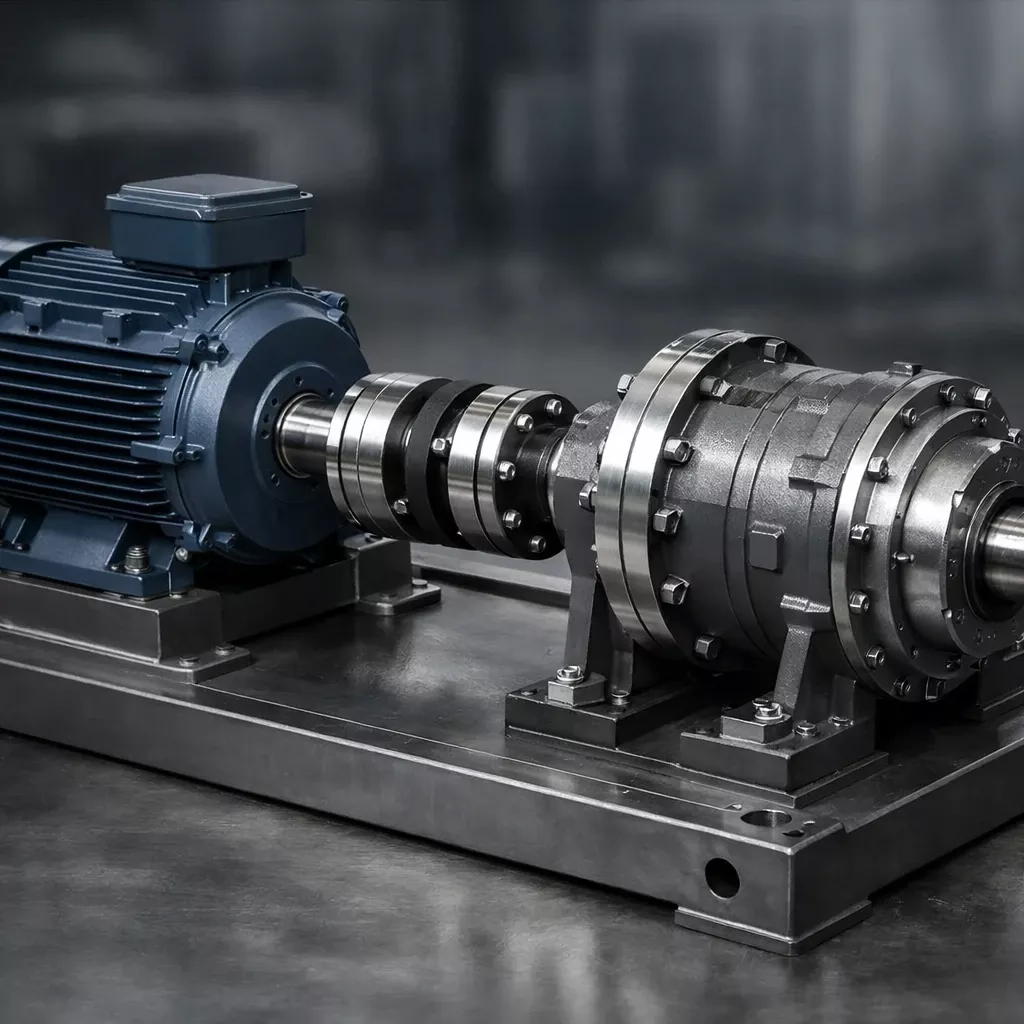
A coupling with excellent nominal torque capacity may be rejected if its stiffness amplifies gearbox bearing loads or excites torsional resonances. This is why OEMs favor components with well-characterized elastic behavior, not just catalog ratings.
Application-driven coupling behavior reference:
2) Rating Methodology Transparency (ISO, AGMA, Internal Models)
OEMs prioritize suppliers who clearly declare how ratings are calculated, not just the final numbers.
Preferred characteristics:
- Explicit reference to ISO 6336 / AGMA 2101 / ISO 281
- Clear service factor philosophy (what is included, what is not)
- Published assumptions for duty cycle, load spectrum, and shock classification
Red flag:
“This gearbox is rated for 250 kNm” without stating rating standard, service factor basis, or duty profile.
For planetary systems especially, OEMs value suppliers whose rating methodology aligns with system-level load distribution assumptions (planet load sharing, housing stiffness, carrier deflection).
3) Interface Engineering and Dimensional Discipline
OEMs strongly favor components that integrate without field adaptation.
Critical interface criteria:
- Standardized shaft diameters, keys, splines
- Controlled runout and concentricity
- Predictable hub fits (ISO/DIN tolerance classes)
- Availability of spacer couplings for maintenance access
Every on-site modification increases:
- alignment error risk,
- balance degradation,
- responsibility ambiguity.
This is why coupling systems with modular hubs and standardized interfaces are preferred in multi-OEM drive trains.
4) Misalignment Management Strategy
No industrial drive operates at perfect alignment after thermal stabilization.
OEMs evaluate:
- Allowable angular, parallel, and axial misalignment
- Load penalty induced by misalignment
- Behavior under combined misalignment + torque ripple
Elastomeric coupling systems are often selected not because they are “soft,” but because they decouple alignment error from bearing damage, especially in drives with:
- flexible foundations,
- long shaft spans,
- temperature gradients.
Coupling misalignment behavior reference:
5) Reliability Evidence and Failure Mode Transparency
OEM selection strongly favors suppliers who openly document:
- typical failure modes,
- wear patterns,
- inspection intervals,
- condition monitoring compatibility.
Engineers trust OEMs who can say:
“This component fails this way under these conditions—and here is how you detect it early.”
Opaque reliability claims are treated with skepticism, especially in:
- mining,
- cement,
- steel,
- continuous-process industries.
6) Serviceability and Lifecycle Engineering
Drive components are selected for 30–60% of their lifecycle cost, not purchase price.
OEMs assess:
- ease of element replacement (especially couplings),
- bearing and seal accessibility,
- lubrication system maintainability,
- spare parts logistics and interchangeability.
Spacer couplings, cartridge-style seals, and standardized elastomer elements often outweigh small efficiency gains when uptime is critical.
7) Documentation, Traceability, and Engineering Support
In modern projects, documentation quality is a selection criterion.
Preferred OEM characteristics:
- dimensional drawings with tolerances
- load rating calculation notes
- installation and alignment guidance
- declared compliance with standards
- serial traceability for critical components
This is especially decisive in EPC-led or regulated projects where documentation gaps delay commissioning more than hardware issues.
8) Digital Integration and Engineering Data Availability
Forward-looking OEMs support:
- CAD/STEP models
- mass and inertia data
- stiffness and damping parameters
- simulation-ready datasets
These allow:
- torsional analysis,
- vibration prediction,
- foundation interaction modeling.
OEMs lacking digital transparency are increasingly excluded from complex drive projects—not due to quality issues, but due to integration friction.
9) Risk Allocation and Accountability
OEM selection is also about risk ownership.
Engineers ask:
- Who owns performance if misalignment occurs?
- Who defines acceptable installation tolerance?
- Who supports root-cause analysis after failure?
OEMs with application engineering teams and clear boundary definitions are preferred over vendors who only supply hardware.
Conclusion
OEM selection for industrial drive components is an exercise in systems engineering, not catalog comparison. Torque capacity, efficiency, and price are necessary—but insufficient.
The decisive criteria are:
- compatibility with system behavior,
- transparency of rating logic,
- interface discipline,
- misalignment resilience,
- lifecycle serviceability,
- and engineering accountability.
When these criteria are met, drive systems transition from “installed equipment” to predictable, durable industrial assets.
