
OEM Design Constraints in Large‑Scale Projects
Introduction
Large‑scale industrial projects impose a fundamentally different design reality on OEMs compared to standalone or small‑batch machinery. In these environments, design decisions are rarely optimized for a single component or subsystem. Instead, OEM engineers operate within a dense web of technical, contractual, logistical, and lifecycle constraints that directly shape drive system architecture.
Industrial couplings and planetary gearboxes are often where these constraints become most visible. They sit at the intersection of torque transmission, alignment tolerance, safety compliance, serviceability, and system integration. Understanding OEM design constraints is therefore essential for interpreting why large‑scale drive systems are engineered the way they are—and why seemingly “overdesigned” or “conservative” solutions are often intentional.
Constraint 1: System‑Level Standardization Across Multiple Units
Large‑scale projects almost never involve a single machine. They involve:
- Dozens or hundreds of identical or near‑identical drive systems
- Parallel installation schedules
- Distributed maintenance teams
OEMs are therefore constrained to standardized architectures that can be replicated with minimal variation. This limits the use of highly optimized but application‑specific components.
For couplings and gearboxes, this means:
- Preference for proven, widely supported designs
- Avoidance of narrow operating windows
- Selection of components with broad tolerance for misalignment and load variation
Standardization reduces engineering risk, commissioning time, and spare‑parts complexity—even if it sacrifices theoretical efficiency.
Constraint 2: Installation and Alignment Uncertainty
In large‑scale industrial installations, OEMs must assume that perfect alignment will not be achieved in the field.
Factors include:
- Civil construction tolerances
- Foundation settlement
- Thermal growth during commissioning
- Installation by third‑party contractors
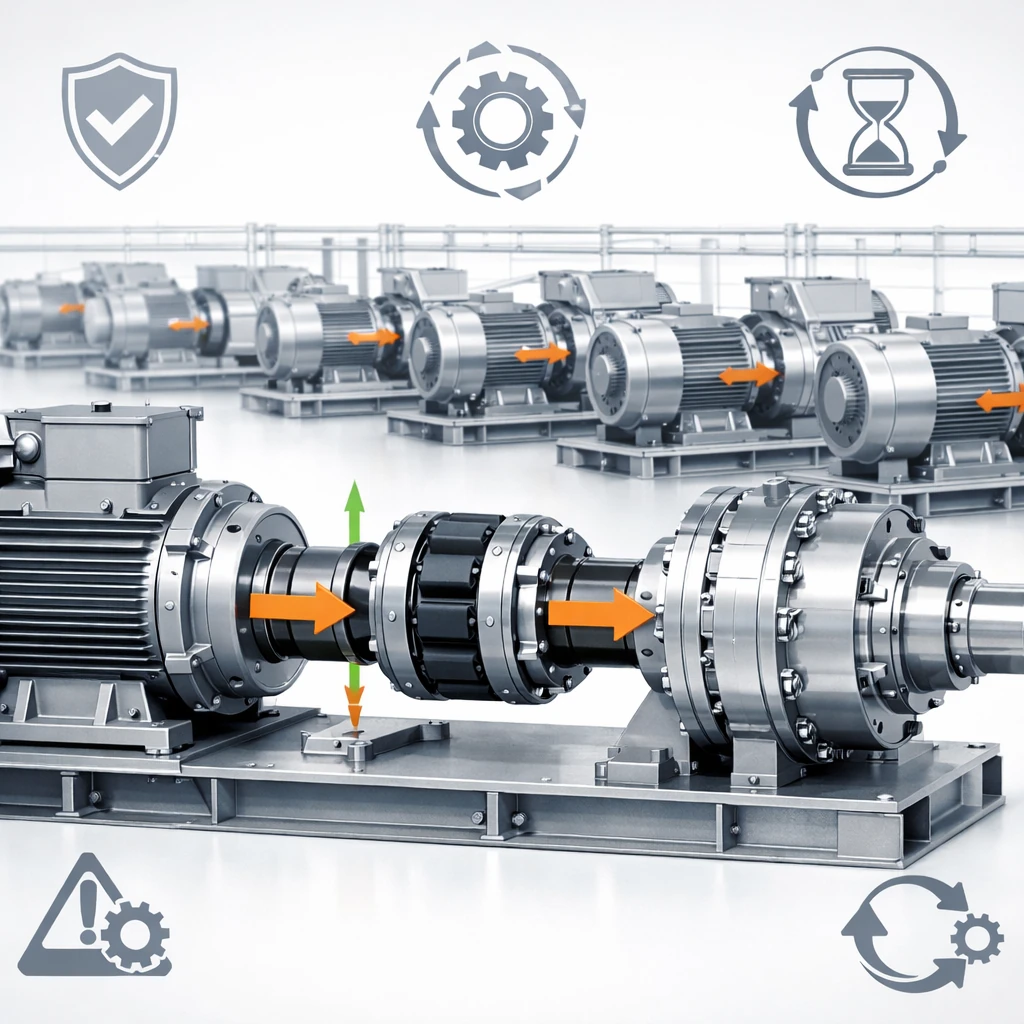
As a result, OEMs deliberately design for alignment forgiveness. This is where coupling selection becomes critical. Rigid torque transmission may satisfy static calculations but fails under real installation conditions.
Elastic and rubber couplings introduce controlled compliance that absorbs:
- Angular misalignment
- Axial displacement
- Micro‑movement during operation
This design philosophy is widely reflected in large‑scale OEM drive architectures and is a key reason elastomer‑based solutions are frequently specified
(see system‑level coupling concepts at: SEAWIDE-RUBBER).
Constraint 3: Load Uncertainty and Transient Behavior
OEMs involved in large‑scale projects rarely receive perfectly defined load data. Instead, they face:
- Conservative or incomplete load specifications
- Variable operating modes
- Unknown future process changes
Designing to nominal torque values alone is unacceptable. OEMs must account for:
- Start‑up torque amplification
- Shock loading
- Emergency stops
- Process upsets
Planetary gearboxes are often selected for their compact torque density, but their internal load sharing is sensitive to torsional stiffness upstream. OEMs therefore treat the coupling as an active element in managing transient behavior, not a passive connector.
Constraint 4: Compliance, Liability, and Risk Allocation
In large projects, OEMs carry substantial contractual liability. Failure modes that might be acceptable in small machinery become commercially catastrophic at scale.
Design constraints driven by liability include:
- Predictable failure behavior
- Damage containment
- Avoidance of cascading failures across systems
From this perspective, controlled compliance is a risk‑mitigation strategy. A coupling that deforms elastically under overload protects downstream gear stages, shafts, and bearings—reducing the likelihood of system‑wide failure and legal exposure.
Constraint 5: Maintenance Accessibility and Lifecycle Cost
Large‑scale installations are maintained over decades, often by teams that were not involved in the original project.
OEMs must therefore design for:
- Predictable wear behavior
- Visual inspectability
- Modular replacement
Couplings are frequently selected as serviceable sacrificial components, intended to absorb wear and be replaced without disturbing the gearbox or motor alignment. This lifecycle‑oriented constraint heavily influences material choice, stiffness, and coupling architecture.
Constraint 6: Supply Chain and Global Availability
Large projects are often executed across multiple regions, sometimes under volatile supply conditions.
OEM design constraints therefore include:
- Global availability of components
- Multiple qualified suppliers
- Long‑term spare parts continuity
This discourages exotic or proprietary solutions and favors coupling and gearbox designs with:
- Established manufacturing bases
- Interchangeable elements
- Documented long‑term support
Why OEM Designs Look “Conservative” — and Why That’s Intentional
To an external observer, OEM drive designs in large‑scale projects may appear oversized, overly flexible, or insufficiently optimized.
In reality, they reflect a rational response to:
- Uncertainty
- Scale
- Risk exposure
- Lifecycle responsibility
OEMs are not optimizing for peak efficiency at a single operating point. They are optimizing for system survivability over decades of imperfect operation.
Engineering Summary
- OEMs in large‑scale projects design under systemic constraints, not isolated component logic
- Standardization and repeatability override local optimization
- Alignment and load uncertainty drive the use of compliant coupling solutions
- Compliance and liability considerations shape mechanical architecture
- Lifecycle serviceability is a primary design driver
- Conservative design is a deliberate risk‑management strategy
