

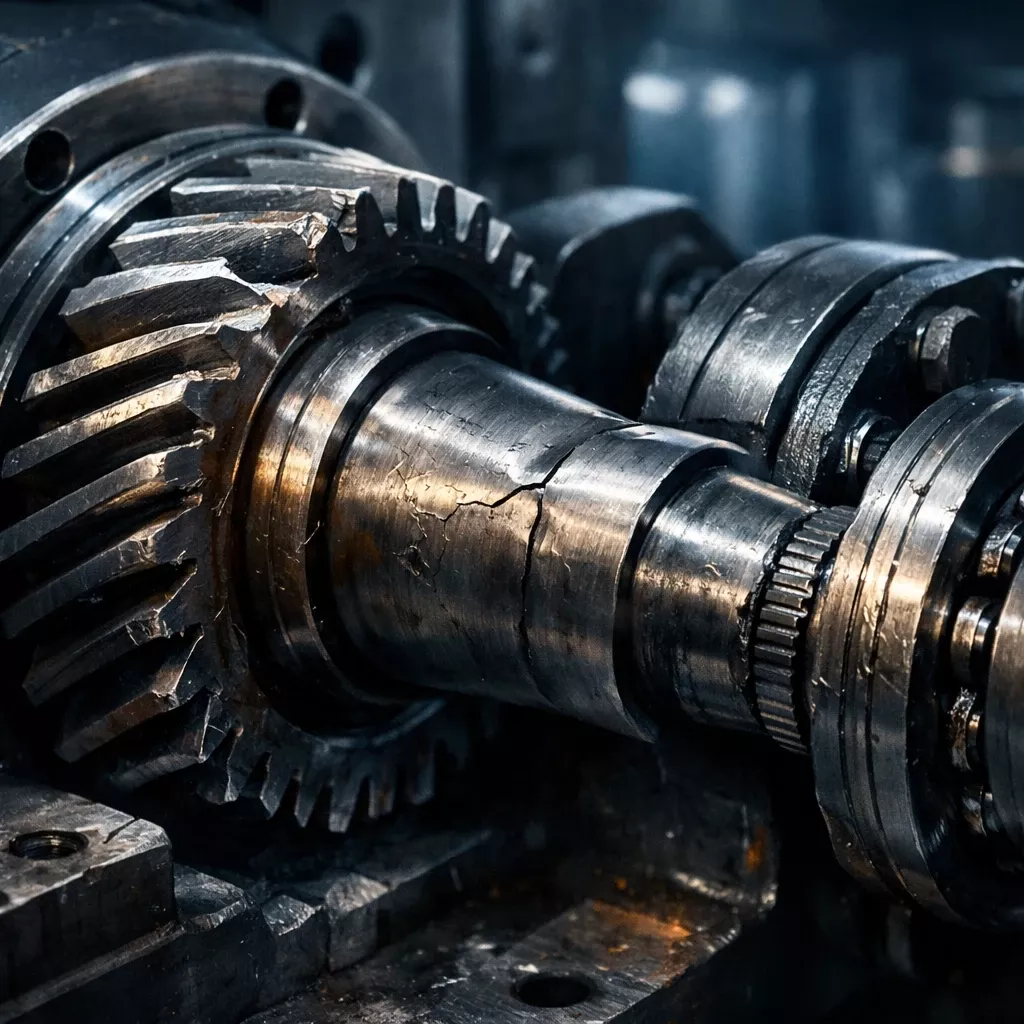
Load‑Induced Failures in Power Transmission Systems
Introduction
Load‑induced failures in power transmission systems are rarely caused by excessive power alone. They originate from how load is defined, distributed, distorted, and transmitted through interconnected components over time. In industrial environments, mechanical systems fail not because a single element exceeds its rating, but because load paths evolve under real operating conditions. These evolving load patterns initiate fatigue mechanisms that propagate across gears, bearings, shafts, couplings, and supports until failure becomes visible.
Load Definition Versus Real Operating Load
Design calculations often rely on steady‑state torque values, yet real systems operate under variable, transient, and asymmetric loading. Start‑ups, shutdowns, emergency stops, material inconsistencies, and process interruptions introduce torque spikes that far exceed nominal values. These short‑duration events may not trigger protective systems, but they impose cyclic stress on mechanical interfaces. Over time, these stresses accumulate as fatigue damage, leading to failures that appear random but are fundamentally load‑driven.
Uneven Load Distribution in Mechanical Systems
Load is rarely shared evenly across components, even in systems designed for balanced operation. Gear tooth contact patterns, bearing preload variations, shaft deflection, and housing elasticity cause localized stress concentration. In planetary gear systems, for example, minor geometric deviations result in unequal load sharing between planets, accelerating tooth and bearing fatigue. These imbalances persist throughout operation, allowing damage to grow silently until one component fails and abruptly redistributes load to the remaining elements.
Elastic Deformation and Load Distortion
Under high torque, shafts, housings, and mounting structures elastically deform, altering alignment and contact geometry. This deformation shifts load away from intended paths and introduces secondary forces such as bending moments and axial thrust. Bearings experience edge loading, seals operate under eccentric conditions, and gear meshes develop non‑uniform contact. Because elastic deformation is reversible, it often escapes detection during inspections, yet it continuously drives fatigue mechanisms within the system.
Coupling‑Induced Load Amplification
Couplings play a critical role in how load is transmitted and transformed. Excessively stiff couplings transmit misalignment forces directly into bearings and gear meshes, amplifying load beyond design assumptions. Conversely, highly flexible couplings can introduce torsional oscillations that cyclically overload shafts and gear teeth. In both cases, the coupling does not fail first; instead, it modifies the load environment in a way that accelerates downstream damage, a recurring pattern observed in industrial drive evaluations at SEAWIDE-RUBBER.
Shock Loads and Transient Events
Shock loading is one of the most destructive yet underestimated sources of load‑induced failure. Sudden engagement, material jams, or control system delays generate impact forces that exceed static ratings by orders of magnitude. These events create micro‑cracks in gear teeth, brinelling in bearings, and plastic deformation at key interfaces. Although the system may continue operating normally afterward, each shock advances the failure process along a predictable trajectory.
Load Interaction With Speed and Environment
Load does not act independently; it interacts with speed, lubrication regime, and environmental conditions. High loads at low speeds compromise lubricant film formation, increasing metal‑to‑metal contact. Elevated temperatures reduce lubricant viscosity, further magnifying load effects. Contaminants introduced through the operating environment increase friction and abrasive wear, intensifying stress concentration. These interactions explain why load‑induced failures often coincide with environmental or operational changes rather than obvious overload events.
Maintenance Practices That Reinforce Load Errors
Replacing failed components without correcting load distortion allows the same failure mechanism to restart. Bearings are changed, gears are rebuilt, and couplings are replaced, yet the underlying load path remains unchanged. Alignment is restored statically, but elastic deformation under operating load is ignored. As a result, the new component inherits the same stress conditions as its predecessor, leading to repeated failures that appear unrelated but share a common load‑based origin.
Conclusion
Load‑induced failures in power transmission systems emerge from how forces are introduced, distributed, and transformed across interconnected components. Misdefined operating loads, uneven load sharing, elastic deformation, coupling behavior, and transient shock events combine to create failure chains that evolve silently over time. Understanding load as a dynamic, system‑level phenomenon rather than a static design input is essential for breaking these cycles. Systems that address load paths holistically achieve reliability not by increasing component ratings, but by controlling how load flows through the entire transmission architecture.
