
Introduction
In modern industrial machinery, compliance requirements are not external constraints imposed after design completion—they are fundamental engineering parameters that shape the architecture, behavior, and long-term reliability of drive systems. In applications involving industrial couplings and planetary gearboxes, compliance directly influences torque transmission stability, failure modes, and operational safety.
A drive system may satisfy catalog ratings and still violate compliance expectations once exposed to real operating conditions such as transient loads, misalignment, thermal cycling, or environmental degradation. True compliance is achieved only when regulatory, mechanical, and operational requirements are embedded into the system design from the earliest engineering stages.
Regulatory Compliance in Drive Systems
Regulatory compliance defines the minimum legal acceptability of an industrial drive system. Common frameworks include CE conformity, ISO and IEC mechanical standards, and region‑specific safety regulations.
From an engineering perspective, these regulations:
- Define acceptable risk levels
- Specify documentation and traceability requirements
- Establish baseline safety expectations
However, regulatory approval does not guarantee mechanical robustness. Compliance standards rarely account for application‑specific load spectra, torque peaks, or fatigue accumulation. Engineers who design exclusively to regulatory thresholds often underestimate dynamic stresses transmitted through gear stages and couplings.
Mechanical Safety Compliance and Energy Control
Mechanical safety compliance is primarily about managing energy, not merely preventing physical contact or guarding rotating parts.
Key safety‑critical behaviors include:
- Response to shock loads and torque spikes
- Predictable overload behavior
- Failure containment within defined system boundaries
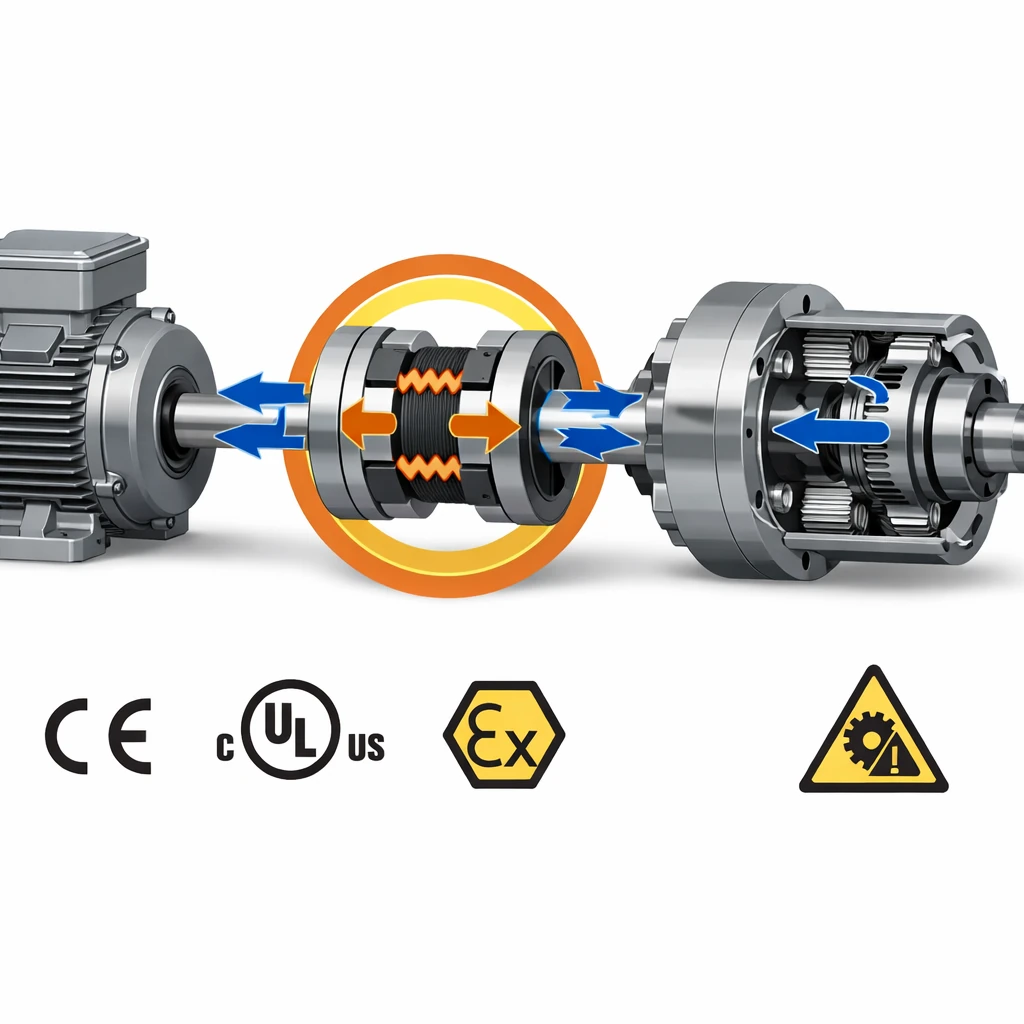
In this context, industrial couplings become safety‑relevant components. Elastic and rubber couplings introduce controlled compliance into the torque path, reducing stress propagation toward gear teeth, bearings, and motor shafts.
This is why many OEM architectures intentionally integrate flexible coupling elements as mechanical fuses or damping interfaces, especially upstream of planetary gearboxes. Properly selected elastomeric couplings significantly improve compliance with mechanical safety objectives
(see coupling behavior concepts at: SEAWIDE-RUBBER).
Performance Compliance Beyond Nominal Ratings
Performance compliance is frequently misunderstood as meeting rated torque, speed, or power values. In real industrial environments, drive systems operate under variable and transient conditions, including:
- Frequent start–stop cycles
- Load reversals
- Partial‑load operation
- Impact loading
Planetary gear systems are particularly sensitive to these conditions due to load sharing mechanisms within the gear stages. Minor elastic deformation or misalignment can alter internal load distribution, pushing individual components beyond compliant stress limits.
Compliance therefore requires validating the drive system against the actual operating load spectrum, not static nameplate values.
Environmental and Lifecycle Compliance
Environmental compliance extends beyond ingress protection or ambient temperature limits. Over time, materials within the drive system change their mechanical behavior.
Critical lifecycle factors include:
- Elastomer aging and stiffness variation
- Thermal degradation under continuous duty
- Chemical exposure from lubricants or process media
A coupling that initially satisfies damping and torsional compliance requirements may lose elasticity over time, increasing torque transmission rigidity and invalidating earlier compliance assumptions. Lifecycle‑based compliance analysis is essential for long‑term reliability.
Documentation, Traceability, and Engineering Accountability
Compliance must be demonstrable, not assumed. Industrial projects require traceable documentation that clearly defines:
- Design assumptions
- Load cases and safety factors
- Component selection logic
- Responsibility boundaries between OEMs, integrators, and end users
In mature engineering organizations, documentation is treated as part of the design process itself. This ensures that when operating conditions evolve, compliance can be re‑evaluated systematically rather than reactively.
Compliance as a System Design Strategy
When correctly integrated, compliance does not restrict design freedom—it eliminates fragile architectures.
A compliant industrial drive system:
- Manages energy flow rather than resisting it
- Uses controlled mechanical compliance to protect critical components
- Aligns component behavior with real operating conditions
- Maintains predictable performance over its service life
This system‑level approach is increasingly critical in high torque density applications and planetary gearbox systems where small deviations can trigger cascading failures.
Engineering Summary
- Compliance is a system‑level engineering requirement
- Regulatory standards define legality, not durability
- Mechanical safety depends on controlled compliance
- Real load spectra matter more than nominal ratings
- Environmental effects evolve over time
- Documentation is an engineering responsibility
