
Alignment Chains and Error Propagation in Drive Systems
Introduction
In industrial drive systems, alignment is often treated as a localized mechanical adjustment.
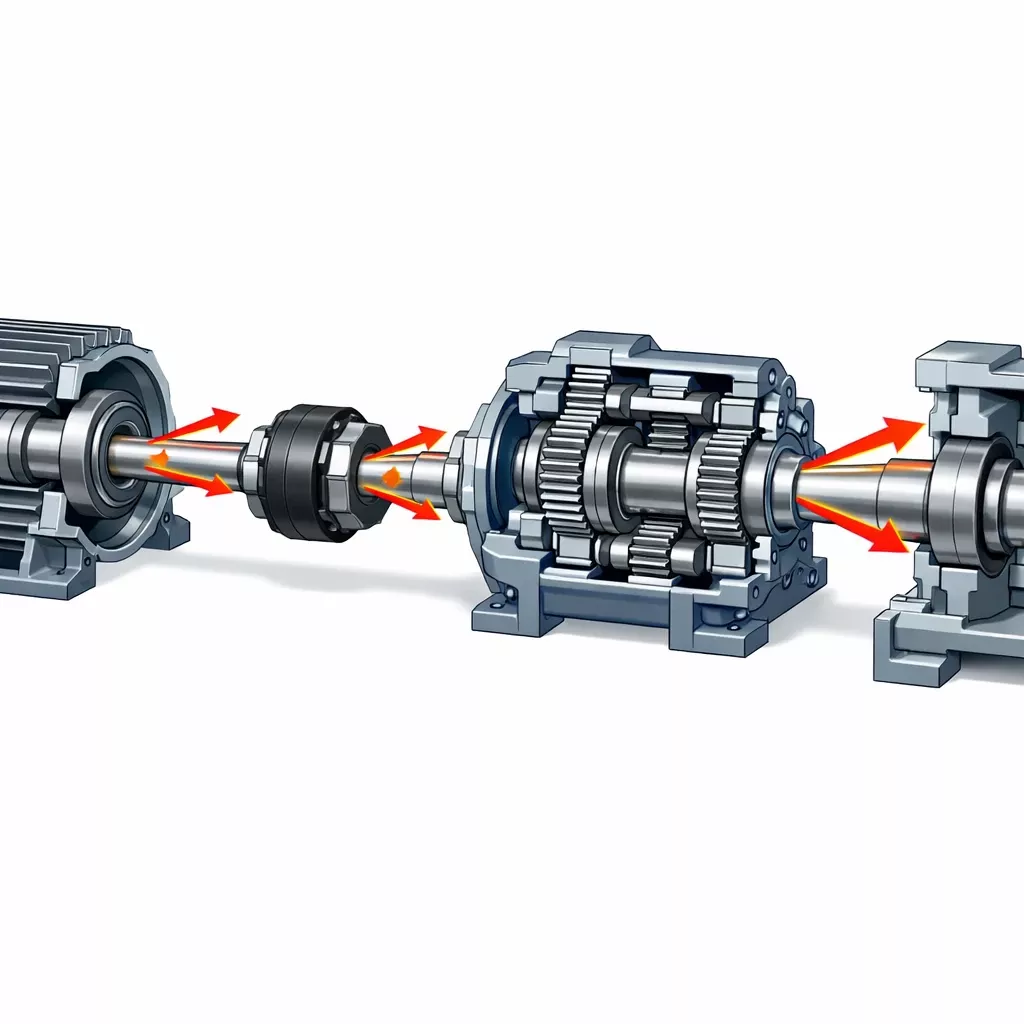
In reality, alignment behaves as a system‑wide condition, governed by a sequence of geometric dependencies commonly referred to as alignment chains.
A deviation introduced at the motor feet, coupling interface, or gearbox mounting surface does not remain confined to that location. Instead, it propagates through shafts, bearings, gear meshes, and structural supports—transforming minor installation inaccuracies into progressive mechanical stress across the drivetrain.
Understanding alignment chains is therefore essential for engineers seeking long‑term reliability rather than short‑term operational acceptance.
Alignment as a Chain, Not a Point
An alignment chain consists of all mechanical interfaces that define the rotational axis of a drive system:
- Motor shaft centerline
- Coupling elastic center
- Gearbox input and output shafts
- Baseplate geometry
- Driven equipment shaft
Each element inherits the positional and angular condition of the previous one.
As a result, alignment errors are cumulative.
Even when individual misalignments fall within permissible tolerances, their combined effect can exceed safe operational limits once load, speed, and thermal growth are introduced.
Mechanisms of Error Propagation
Angular Misalignment Propagation
Angular errors generate bending moments that travel through couplings into gearbox bearings. These moments increase edge loading, reduce lubricant film stability, and accelerate fatigue damage.
Parallel Offset Accumulation
Parallel misalignment creates cyclic radial forces that are transmitted downstream, particularly harmful in rigid gear stages where flexibility is limited.
Axial Position Drift
Axial misplacement often originates from thermal expansion or mounting distortion and leads to unstable thrust bearing behavior inside gear units.
Flexible elements mitigate—but do not eliminate—these effects. Rubber couplings, for example, act as torsional and radial buffers, reducing stress transmission while preserving torque continuity. This buffering role is why elastomeric coupling design remains central to industrial drivetrain stability, particularly in environments with structural variability (see practical coupling behavior references at SEAWIDE-RUBBER).
Couplings as Error Moderators, Not Error Fixes
A common misconception is that flexible couplings “solve” alignment problems.
In practice, they moderate error transmission, buying time rather than removing root causes.
Key engineering implications:
- Excessive reliance on coupling flexibility masks installation issues
- Over‑flexibility can introduce torsional instability
- Under‑flexibility transfers stress directly to gearboxes
Correct coupling selection must therefore consider:
- Expected alignment drift
- Load fluctuation profile
- Structural stiffness of foundations
This is especially critical in heavy industrial applications where alignment conditions evolve throughout the operating lifecycle.
Error Amplification Inside Gearboxes
Once alignment errors enter a gearbox, particularly planetary systems, their impact multiplies:
- Uneven load sharing across gear meshes
- Asymmetric bearing loading
- Localized thermal hotspots
Planetary gear arrangements are efficient but geometrically sensitive. Small deviations disturb symmetry, leading to accelerated wear patterns and reduced service life. This sensitivity explains why gearbox failures frequently appear disconnected from their true upstream alignment origins.
Structural Foundations and Hidden Alignment Drivers
Many alignment chains originate below visible components:
- Soft foot conditions
- Baseplate deformation
- Uneven grout stiffness
- Thermal gradients between machine elements
These factors alter alignment after commissioning, creating delayed failure modes. This explains why many drivetrains operate acceptably during initial testing but degrade under continuous duty.
Alignment must therefore be treated as a dynamic condition, influenced by load, temperature, and time.
Alignment Chains vs Traditional Maintenance Thinking
| Traditional View | Alignment Chain View |
|---|---|
| Shaft‑to‑shaft focus | System‑wide geometry |
| Static measurement | Load‑dependent behavior |
| Installation task | Lifecycle condition |
| Component failure | Failure propagation |
Ignoring alignment chains leads to predictable outcomes: premature coupling fatigue, bearing failures, seal leakage, vibration escalation, and unplanned downtime.
Engineering Implications for Design and Operation
Best‑practice principles derived from alignment chain analysis:
- Design drivetrains with controlled flexibility zones
- Validate alignment under operating load
- Re‑verify alignment after thermal stabilization
- Monitor vibration patterns for propagation signatures
Rubber couplings play a critical role in these strategies by absorbing transient misalignment and damping torsional oscillations without introducing rigid load paths (practical selection logic discussed at SEAWIDE-RUBBER).
Conclusion
Alignment errors are not isolated defects; they are transmitted states.
Once introduced, they move through the drivetrain, evolve under load, and eventually manifest as mechanical failure.
Viewing alignment through the lens of chains and propagation shifts engineering focus from tolerance compliance to system integrity—which is where real reliability is determined.
